
Licence to Improve
There are certain things an angler needs before heading to the river. A rod is generally useful. A reel helps. Flies are advisable, although judging by the contents of most fly boxes I see, apparently several hundred more than you could conceivably use in a lifetime are always preferable!
And then there's your EA rod licence…
If you fish for salmon, trout or freshwater fish in England and Wales, you need one. It might not be the most exciting bit of fishing tackle you'll ever buy, but unlike most of the contents of my fishing pack, this particular purchase actually has a very good chance of improving the river. Later this month, we're going to see a little of that money being put back into the catchment.
Where does the money go?
One question anglers quite reasonably ask is, what actually happens to rod licence money? Part of the answer is the Environment Agency's Fisheries Improvement Programme, or FIP… everyone loves an acronym!
The programme takes some of the money generated through the sale of fishing licences and puts it back into projects that protect and improve fish stocks, fisheries and habitat. Crucially, that investment can also help unlock additional contributions from organisations, angling associations and local partners. And since its inception, the numbers are quite impressive.
Since FIP began in 2015, £10 million of fishing licence income has supported around 1,600 projects across England. Partner organisations have added another £15 million, creating a total pot of £25 million to invest in fisheries! That's the bit I particularly like. One pot of money helps another go further. And, in our case, FIP funding is being combined with contributions from the Upper Teign Fishing Association and us to carry out practical habitat improvements on a stretch of the upper river.
A bit of work for the river
On 22nd & 23rd September, we'll be getting into the river and putting that investment to work. Earlier walkovers of this particular stretch highlighted several opportunities where relatively simple interventions could make a real difference. There are sections of eroded bank that we'll be repairing using felled trees and natural materials, creating a more stable and varied river margin rather than simply allowing erosion to continue unchecked and generally degrading things.
Where timber is being used to reinforce and reform those banks, we'll secure it using natural manila rope. It's something our friends at the Environment Agency are keen for us to use when working in and around the river, for the fairly obvious reason that if a fixing eventually breaks, works loose or disappears downstream, we're not introducing lengths of synthetic material into the environment.
There is something rather pleasingly straightforward about the whole approach. Trees from beside the river, secured with rope made from natural fibre, being used to help the river repair itself. One of those jobs where there’s no plastic cable ties required!
We'll also be managing some of the bankside trees to improve the dappled shade over important riffle habitat. Shade has featured rather heavily in our conversations this summer, and for good reason. Trees alongside rivers help regulate water temperature, provide cover, contribute woody material and create the mixture of light and shade that healthy river habitats need. But this isn't about simply planting as many trees as possible and walking away. Sometimes the trees need managing too.
Careful coppicing can open small areas of the canopy while encouraging fresh growth, creating that patchwork of sunlight and shade rather than either a completely exposed or completely enclosed river. And some of what we cut will immediately start another job.
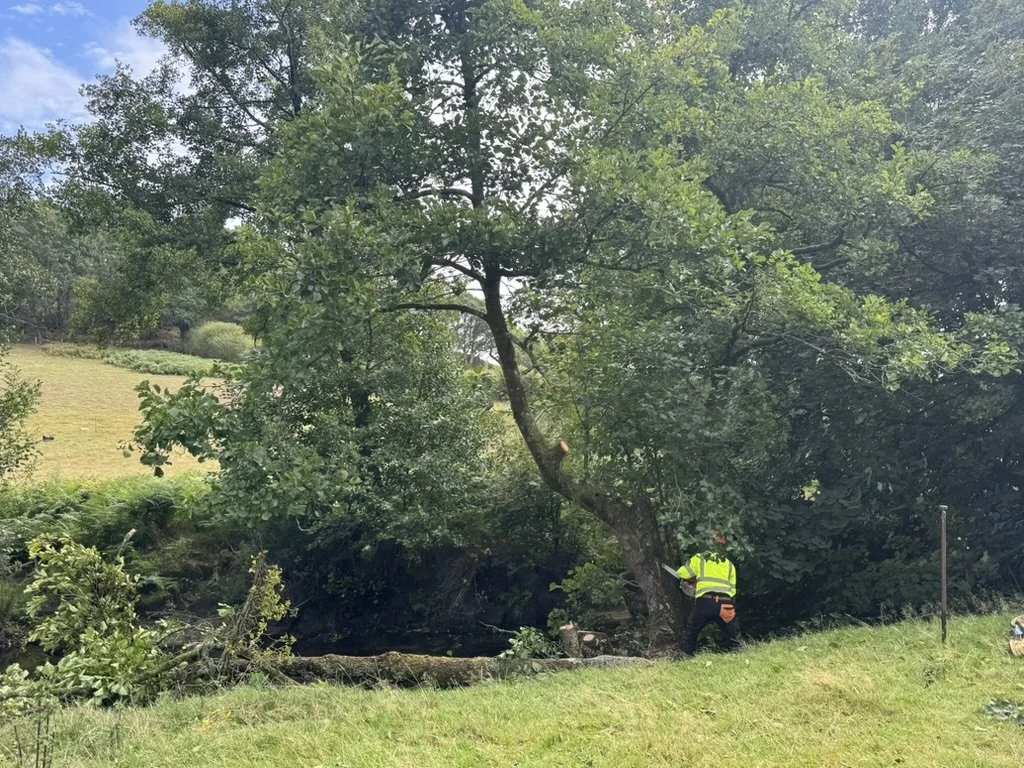
Willow doing what willow does
Green willow will be coppiced and used to create willow slips, which can then be planted into vulnerable sections of riverbank. We've talked about these before, and I love them largely because they're such a wonderfully uncomplicated bit of river restoration. Cut a suitable piece of living willow, push it well into damp ground and, given half a chance, it will grow. As the willow establishes, its roots begin binding the soil together, helping stabilise the bank naturally. Above ground, the new growth eventually provides shade and cover; around the water's edge, roots and vegetation add complexity and refuge for fish and other wildlife. No concrete involved, just convincing a tree to start again somewhere useful.
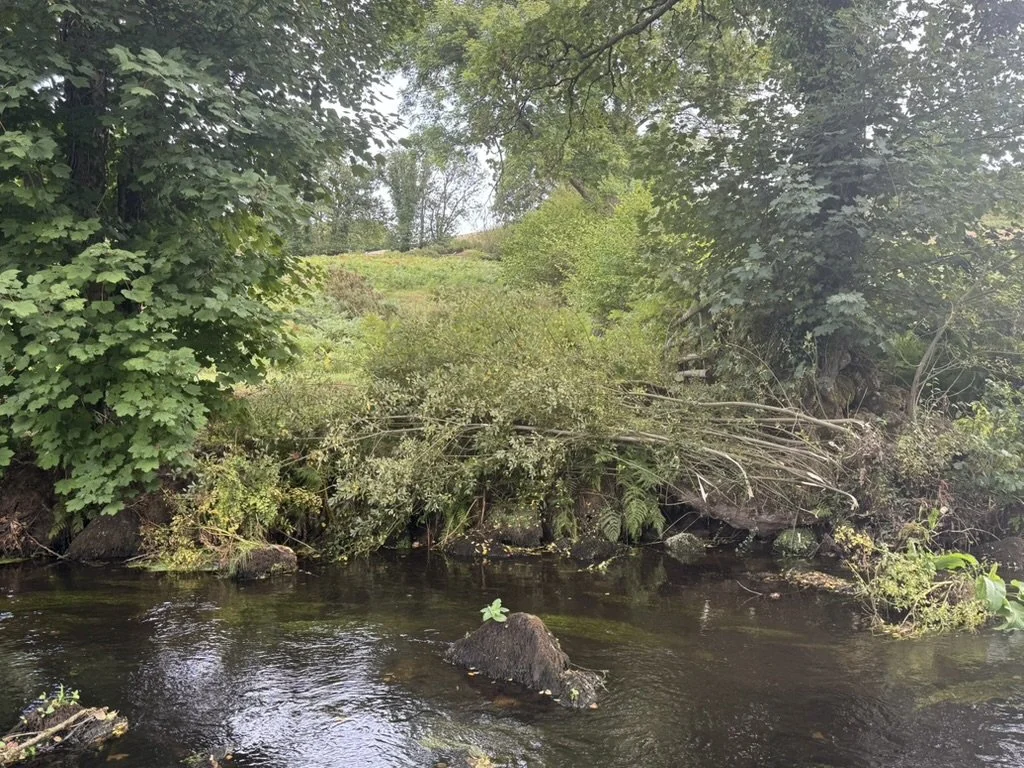
A nice piece of live laid hedge to close of an open section…
Why interfere at all?
It's a fair question, and one passers-by often bring up when we're out in the field doing the work. We frequently talk about allowing rivers to behave naturally, so why are we deliberately putting trees into banks, coppicing willow and tinkering with the river?
Because many of our rivers are no longer operating within entirely natural landscapes. Over generations we've straightened channels, removed trees and woody material, drained land, simplified banks and disconnected rivers from bits of their floodplains. Add increasingly difficult periods of high temperatures, low flows and sudden high-water events and some reaches simply don't have the resilience they once did. The aim isn't to landscape the river. Quite the opposite. Where we can, we're trying to give natural processes a helping hand… after all, there's a general consensus that good habitat should be messy!
A tree positioned against an eroding bank changes the flow of water and provides structure. Pinned and tied into position with natural manila rope, it can be allowed to settle into the river rather than trying to fight against it. Willow roots bind into the soil. Bankside vegetation provides shade. Woody material traps sediment and organic matter. Riffles provide fast, oxygenated water and important habitat for juvenile salmonids and invertebrates. Individually, none of these things sounds particularly revolutionary, but put enough of them back into a river, however, and you start rebuilding complexity. And rivers, like my life at times, enjoy a bit of complexity!
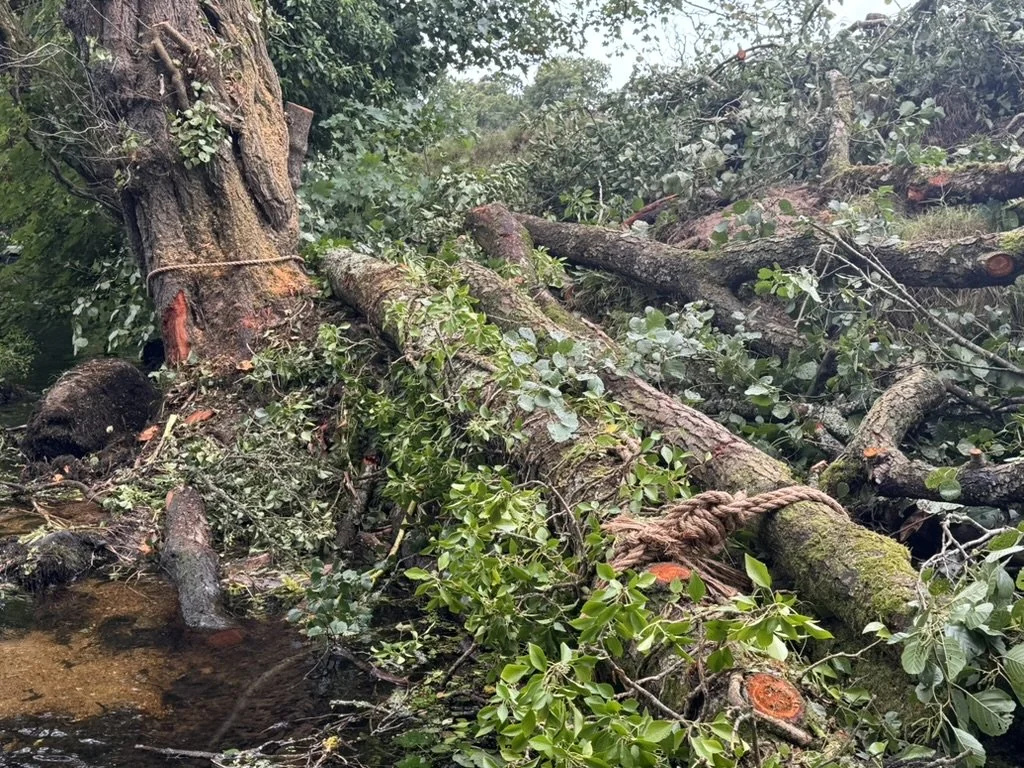
Some large felled timber tied into the bank to restore a heavily eroded section…
None of it happens without access
There's another part of this project which is perhaps less obvious but every bit as important – the landowners…
We can identify potential opportunities, the Environment Agency can provide funding, and volunteers can turn up with wellies and an unhealthy enthusiasm for moving logs around. But somebody ultimately owns the riverbank and land! We are incredibly grateful to the owners of this stretch for engaging with us, allowing access and, most importantly, being willing to work with us to improve the river running through their land. That willingness is absolutely fundamental to what we're trying to achieve across the entire catchment.
The Teign and its tributaries pass through hundreds of individual parcels of land. The more conversations we have with the people who look after those places, the more opportunities there are to make small improvements that collectively begin to make a big difference.
Bringing in the muscle
As this is on private land and outside of the National Trust this time, we'll have the mighty Kier Collings, of Kier Collings Woodland & Estate Management, helping us with the heavier work. I first got to know Kier through the Teign Valley Facilitation Fund and quickly discovered someone with an obvious enthusiasm for making landscapes work better for water and wildlife.
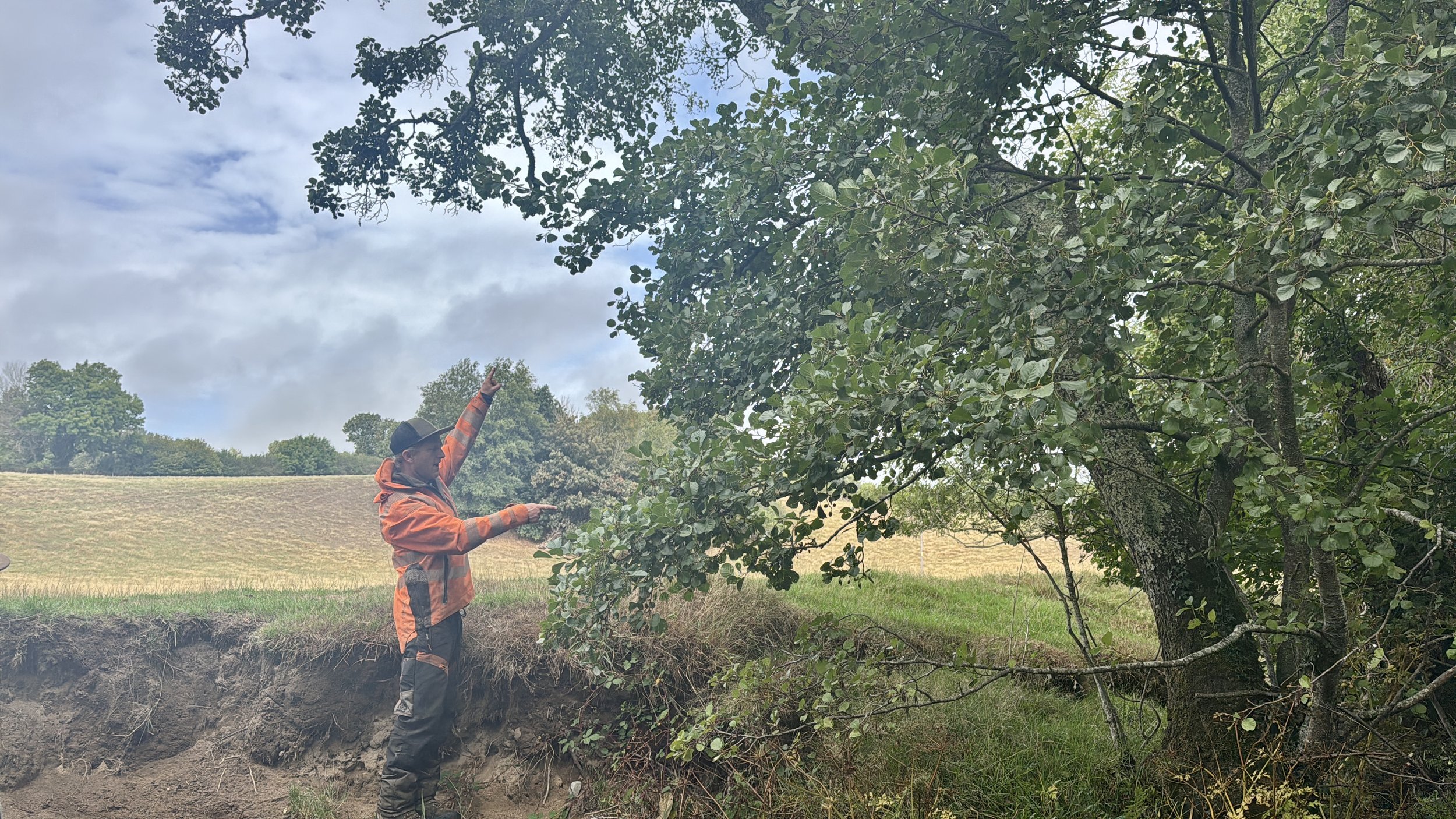
The boy’s got skills… pointing at two things at the same time!…
His experience with Natural Flood Management, woodland management and constructing leaky dams makes him exactly the sort of person you want involved when the job description includes phrases such as "we've got this tree and we'd quite like it over there." Some of Kier's NFM and leaky-dam work can be seen on YouTube:
There's something very satisfying about this sort of work. We're not trying to impose an engineered solution upon the river; we're using the materials already growing beside it to encourage the river to become more varied, more resilient and ultimately better habitat. Ironically, when our towns and villages were being built, people regularly coppiced the bankside trees for building material every 15 to 20 years. Sadly, as the industrial surge has ceased, so has the has the coppicing and we’re now left with some hefty lumps of timber that we’re in danger of losing into the river should banks continue to erode… A simple mantra is, let’s make use of the asset on the river before the river takes it away!
Fancy lending a hand?
And this is where you come in. We'll be carrying out the work over Tuesday 22nd and Wednesday 23rd September, and we'd love some extra hands.
You don't need to be a fisheries scientist, forestry expert or particularly accomplished log wrestler. These days are also an opportunity to come along, learn why we're doing the work and get some practical experience of river habitat improvement. Everyone is welcome and you time given is always appreciated.
We'll meet at Chagford Swimming Pool car park at 10am on both days, before heading to the site, and expect to finish at around 3pm.
As ever with work in and around rivers, the final arrangements will be weather and river-level dependent. Given the summer we've just experienced, cancelling because there's suddenly too much water would at least demonstrate that the weather still has a proper sense of humour!
Please click the button below to register your interest and let us know whether you'd like to join us on the 22nd, the 23rd, or both.
Your licence at work
Something I'd like us all to take away from this one… a rod licence isn't simply a piece of paper that allows you to go fishing. The income it generates supports fisheries work, enforcement, monitoring and practical improvement, and programmes such as FIP allow some of that money to find its way back into rivers like ours. In 2024/25 alone, FIP used just over £1 million of fishing licence income alongside more than £1.2 million of match funding! That's got to be good news for our salmonid friends… and is something I’d like to keep rolling annually to continue the good work.
So if you're going fishing, make sure you've got one.
And if you're wondering what happens to some of that money afterwards… come and join us on one of the volunteering days!