
Riverfly - Life Beneath the Surface
Why Riverfly Monitoring Matters & Why We Need You for 2026!
If you spend enough time in and around rivers, you eventually develop some rather odd habits. Some people begin checking the weather and river level obsessively; others find themselves peering over bridges hoping to spot fish. And then there are those of us who - quite willingly - get in the water, turn over rocks, swirl a net through the gravels, and become far too excited about what crawls into a white sorting tray! Welcome to the wonderful world of Riverfly Monitoring.
Similar to last week’s bit on the lifecycle of Atlantic Salmon, we’re often asked a lot about Riverfly. Questions like why we do it, what we’re looking for, and why volunteers with a bucket and a kick-net are so important to the health of a River.
So, with 2026 fast approaching and a fresh round of training sessions planned for the New Year, now feels like the perfect time to demystify how Riverfly works, why it matters, and why we need more of you involved.

What Exactly Is Riverfly Monitoring?
Riverfly is a nationwide scheme that trains volunteers to regularly sample eight groups of aquatic invertebrates - tiny river residents whose presence (or indeed absence) tells us how healthy the water and habitat are. As the official Riverfly guide states, the goal is to “conserve riverflies and protect river water quality” - A strong and important statement.
These insects spend the early stages of their lives in the river, underwater, making them excellent long-term indicators of what’s really going on beneath the surface. They’re like the canaries of the catchment - only without the singing… We’ll leave that to the happy volunteers!
When conditions are good, and the habitat is there, these species thrive. When something goes wrong - pollution, excess siltation, water temperature spikes - they’re the first indicator to react and disappear. And this reactivity is why the Riverfly Data is so important.
The Magnificent ‘Eight’ - Indicator Species
If you look at the image below, you’ll see wonderfully detailed images of the creatures we depend on to tell the story of river health:
cased caddis, caseless caddis, mayfly larvae, olives, flat-bodied heptageniids, stoneflies, and freshwater shrimp (Gammarus)
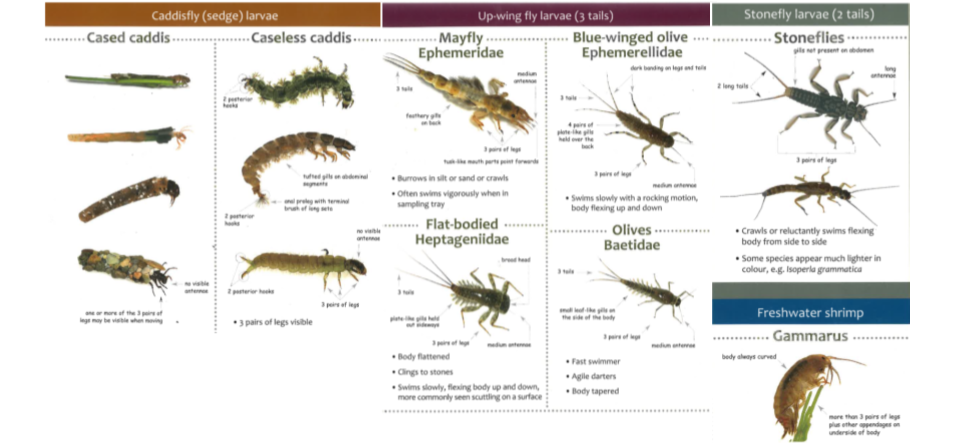
Each group responds differently to water conditions, which gives us a fantastic picture of river health at each surveyed location:
Stoneflies - The divas of the river world. They demand clean, cold, well-oxygenated water.
Mayflies - The free-swimming nymph loves fast, stony riffles
Caddis larvae - The river’s engineers, building tiny survival suits from fine gravel and sediment
Olives & blue-winged olives - Reliable indicators of A1 river habitat.
Gammarus - The workhorses of the food chain, and are normally present where the others aren’t - an indicator of less than ideal water conditions
Monitoring these eight groups gives us a surprisingly accurate picture of river health and data that is far more sensitive and reactive than chemical testing alone.
The Three-Minute Dance
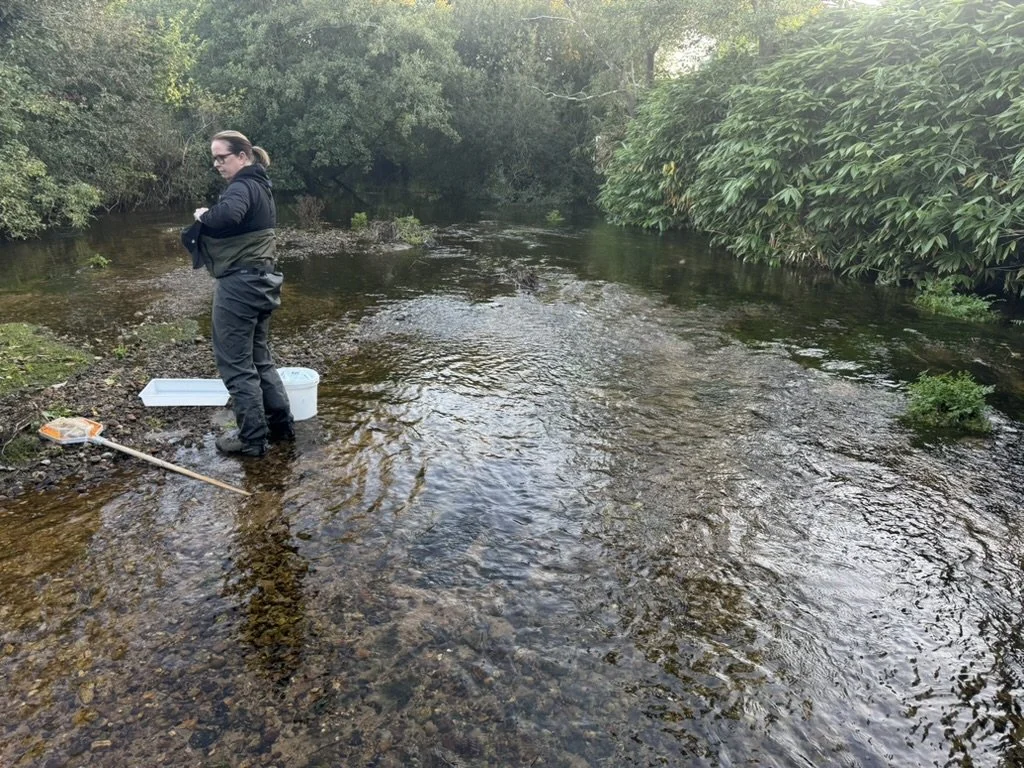
The Riverfly method is simple, standardised, and surprisingly enjoyable! A “three-minute kick sample” is carried out. Think of unleashing your finest soft shoe shuffle on the riverbed to disturb the invertebrates to catch them in a well-placed net downstream. Following this, a one-minute stone search is also carried out to see if anything of interest is lurking under, or clinging to rocks on the riverbed.
It looks something like this:
Stir up the riverbed with your feet while holding a net downstream.
Collect whatever drifts in (trust me, it’s more exciting than it sounds) and you’ll be amazed at how alive the river bed is.
Empty everything into a white tray.
Squint, kneel, grin, and begin counting the myriad of tiny river creatures.
It’s science, but the fun sort, and you’ve got time to enjoy the whole process.
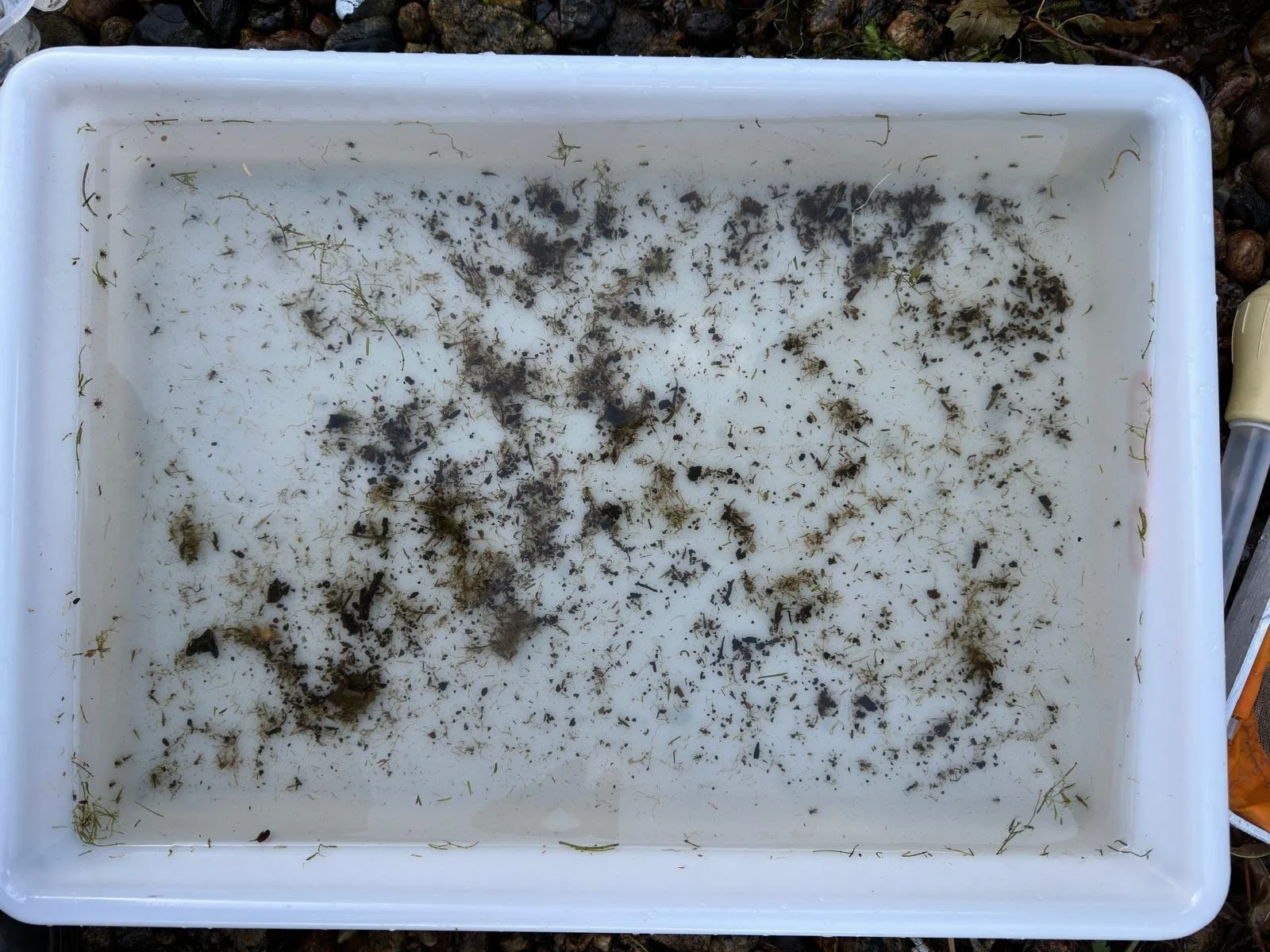
Ready to be counted… OK, it looks like random bits, however, this tray is alive with river invertebrates!
Why These Counts Matter
Here’s the magic of the Riverfly approach - Through it we get consistent monitoring as it always occurs every year across the catchment in May, July, and September. This creates a long-term dataset. When counts are normal or high, we can study what’s working and strong numbers of invertebrates are linked to the following:
clean gravels,
dappled shade,
stable flows,
healthy weed beds,
low silt inputs (good oxygen levels)
And then we replicate that habitat to improve successes elsewhere. Hopefully, you can see that we, with appropriate intervention and improvements, can control all of the above.
But when numbers fall or a site suddenly “under-performs,” it’s a red flag - and an early one allowing us to dig a little deeper to see exactly what’s going on. Pollution incidents, sediment sources, failing banks, excessive water temperature stresses… Riverfly often detects these before anything else does.
And this is why volunteers are so important. This is also why rivers that aren’t blessed with Riverfly coverage and data often remain mysteries - until a larger event occurs and something goes very wrong.
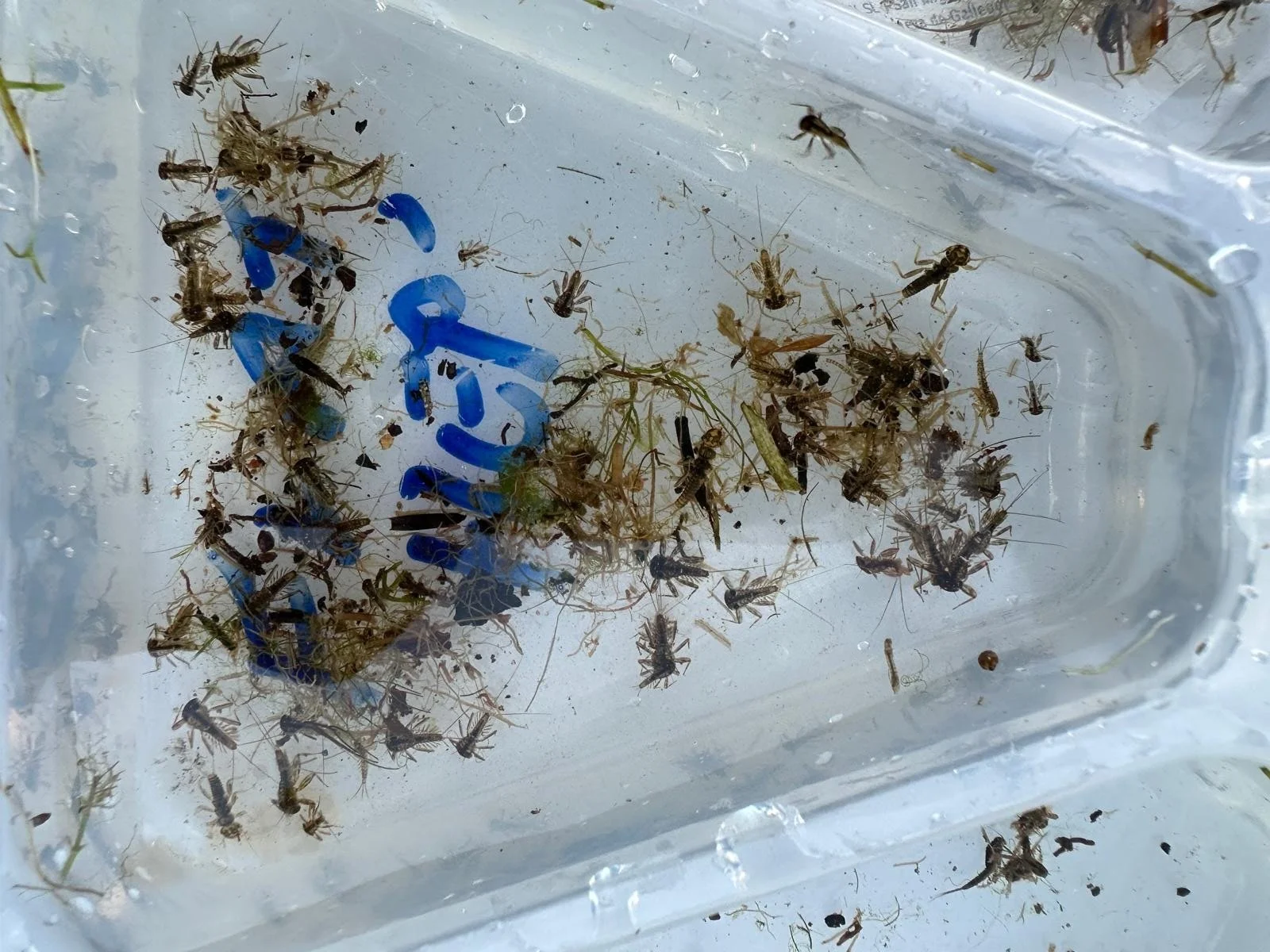
A great count of flat-bodied heptageniids all sorted ready for counting…
A Huge Teign Achievement: Top 10 in the UK
Now here’s something worth celebrating… During the River Teign Restoration Project, our volunteers collected so much high-quality Riverfly data across the catchment that the River Teign ranked in the UK’s Top 10 most surveyed rivers in 2024. I think this alone is an extraordinary testament to the dedication, enthusiasm, and sharp eyes of the volunteers who turned up and sampled in May, July & September, come rain or shine.
Wouldn’t it be brilliant to see the Teign back in that Top 10 again? We think so - and that’s why we’re asking for your help.
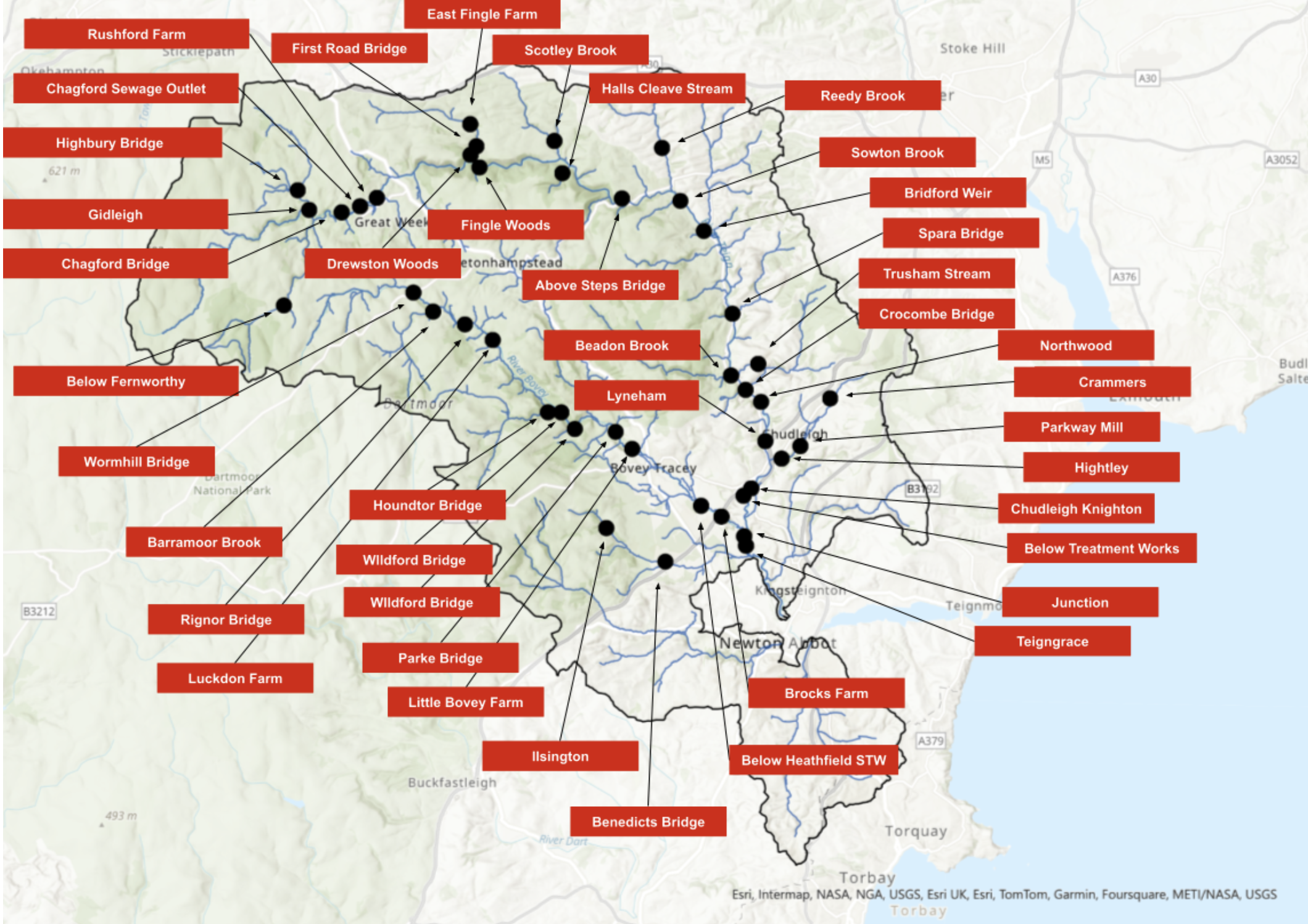
Riverfly sites within the Teign Catchment…
We Need More Riverfly Volunteers for 2026
Riverfly monitoring is one of the simplest, most rewarding ways to directly help the Teign. You don’t need a scientific background - just curiosity, reliability, and a willingness to get into the river three times a year while pretending you know exactly what species you’ve just found (don’t worry… you’ll learn fast), and we will train you…
The commitment:
3 sessions per year in the months of May, July & September
Each session takes about 45 minutes to an hour.
Training provided early in the New Year (watch this space as we’ll be securing a date in the near future).
If you enjoy being outdoors, have an eye for noticing the small details that others walk past, or simply want to contribute something meaningful to the river, then Riverfly is a fantastic place to start. Register your interest below if you’re interested…
A Final Thought
It’s tempting to judge a river by what we see from the surface - flowing water, riffles, a bit of sparkle in the sun. But river health is far more than surface impressions. The true heartbeat of any river lies under the stones, where tiny creatures reveal what’s really going on and lay the foundations for every fish, bird and mammal that depends on the river.
Riverfly monitoring helps us catch problems early, celebrate successes clearly, and understand the Teign in a way no surface-level observation ever could. And with more volunteers, we can expand our coverage across the catchment and continue to build one of the strongest datasets in the country to inform and guide how we can continue to improve and protect valuable river habitat.
If that sounds like something you’d like to be part of, get in touch. We’d love to train up a new cohort of Riverfly guardians for 2026. The river is full of stories and clues, so why not volunteer to help us read them?