
Those of us of a certain age might remember Gala's 1997 hit ‘Freed from Desire’. An absolute staple of the nineties dance era… Well, nearly thirty years later, it turns out that desire is still causing a few problems. Although this time, rather than filling dance floors, it's wearing walking boots and heading towards a river… I'm talking about something known as desire lines.
And if you've ever walked beside a river, through a woodland or across a field and found yourself following a little track that wasn't necessarily the intended path, there's a pretty good chance you've contributed to one. Recently, we've been working alongside our friends at the National Trust in the Fingle Gorge, helping to manage one of these well trodden routes along the Fisherman's Path.
It's a fascinating example of how something as simple as where we choose to put our feet can have rather significant consequences for the wildlife living just a few metres away.
Path of least resistance
A desire line is essentially a route created by people repeatedly choosing to walk somewhere.
Sometimes it's a shortcut across a patch of grass. Sometimes it's a narrow track through woodland. And sometimes it's a little diversion off an established path because there's a particularly good view, an interesting bit or river, or simply somewhere that looks easier to walk.
The interesting thing is that these routes aren't necessarily planned. They develop because people naturally gravitate towards certain places. And rivers tend to be particularly good at drawing us in.
There's actually a growing body of research into what scientists call blue spaces, which includes rivers, lakes and coastal environments. Studies suggest that spending time around water can have measurable benefits for our wellbeing, helping us relax, recover from stress and feel more connected to the natural world. Which probably explains why, given a choice between walking through a field or alongside a river, I know which one I'd choose… Although admittedly, my decision is usually influenced by the possibility of spotting a trout, or knowing there’s a well placed pub at the end of the route!
The sound of running water, the movement, the reflections and the constant possibility of seeing something interesting all encourage us to get that little bit closer. And there's absolutely nothing wrong with that. Until, of course, everybody else has the same idea.
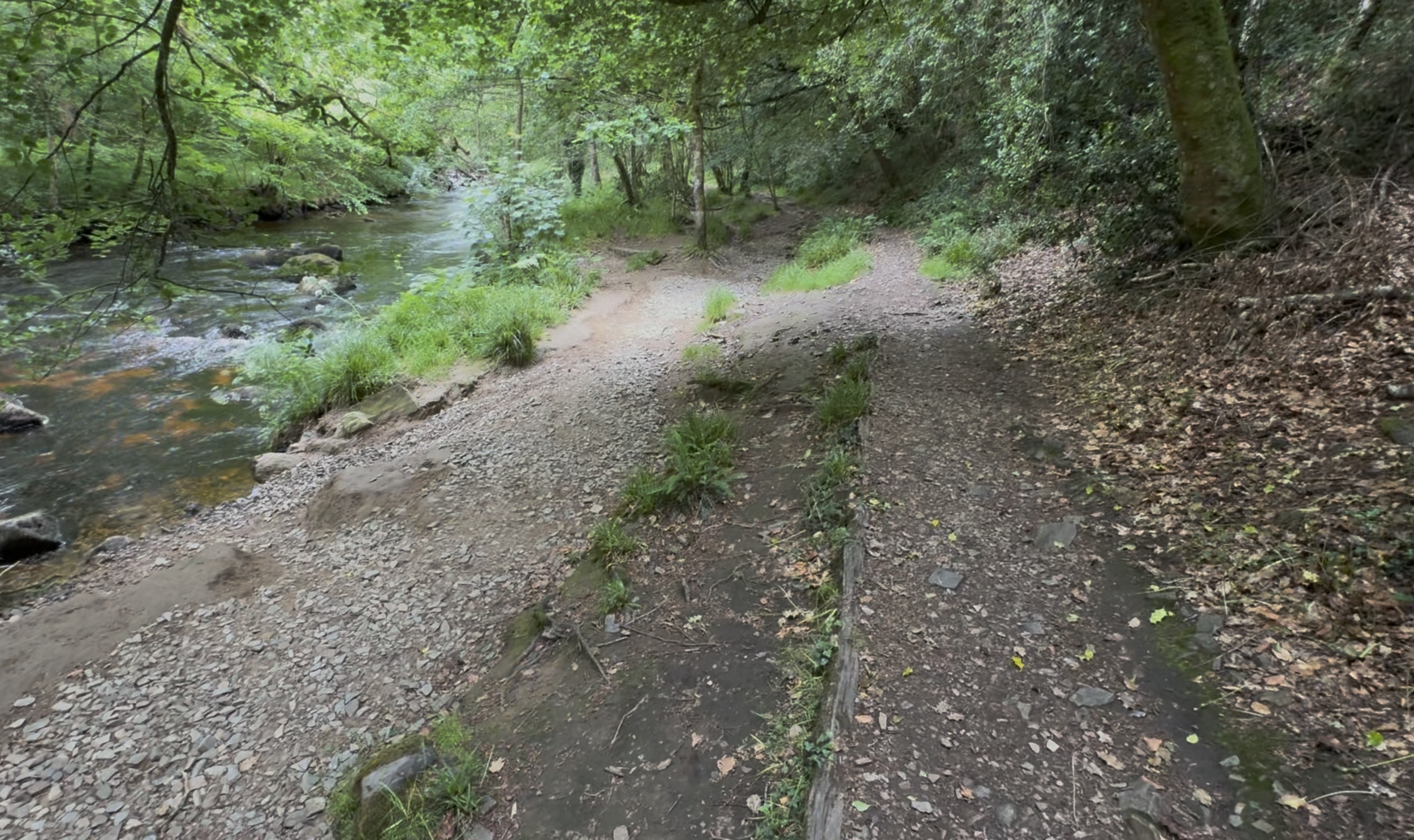
The ‘actual path’ is the one furthest away from the river. This is what we started with. The aim is to promote this as the preferred desire line…
A thousand footsteps
One person walking along a riverbank is unlikely to make much difference. But hundreds or thousands of people repeatedly taking the same little diversion can gradually change the ground beneath their feet. Vegetation becomes worn away. Soil is compressed. Roots become exposed and the bank loses some of the natural protection that plants provide.
Research into heavily used footpaths has demonstrated that repeated trampling reduces the spaces between soil particles, making it harder for water to soak into the ground. Instead, rainfall (please let it rain soon!!!) is more likely to run across the surface, taking loose soil with it.
On a woodland path, that might mean muddy puddles, widening tracks and the occasional rather undignified attempt to retrieve a walking boot. Beside a river, however, the consequences can be more significant. When heavily compacted or exposed banks begin to erode, fine sediment can be washed directly into the water. And depending on where that sediment ends up, it can create problems for some of the river's most important inhabitants.
The trouble with silt
We've talked before about the importance of clean spawning gravels for Atlantic salmon and sea trout. When these fish return to the river to reproduce, they create nests in the riverbed known as redds, where their eggs are deposited amongst the gravel.
Those eggs need a continuous supply of oxygen rich water moving through the spaces between the stones. But when excessive amounts of fine sediment find their way into those spaces, things can become rather difficult.
The sediment reduces the permeability of the gravel, restricting the movement of water and the oxygen around the developing eggs. Research has shown that this can significantly reduce the chances of survival and young fish successfully emerging.
And it's worth remembering that these eggs can remain hidden beneath the gravel for months.
All that effort involved in returning from the Atlantic, finding suitable spawning habitat and producing the next generation can be compromised by conditions that aren't immediately obvious when you look at the river.
Now, sediment is a perfectly natural part of a functioning river. Rivers have always transported, deposited and rearranged material. The problem comes when additional fine sediment enters the system in quantities or locations that overwhelm those natural processes.
Footpath erosion is only one possible source, and certainly not the largest everywhere. But where a heavily used path runs alongside vulnerable banks, particularly upstream of known spawning areas, it's one we can do something about. And that brings us back to Fingle.
Gentle persuasion
The Fisherman's Path through the Fingle Gorge is one of those wonderful places where it's very easy to understand why people want to spend time beside the river. The woodland, the changing light under a canopy of trees, the sound of the river working its way through the valley and the constant temptation to stop and investigate the next pool make it a rather special walk.
But it's also an extremely popular one. With heavy footfall throughout the year, some sections have gradually developed alternative routes and areas of heavily compacted ground where people have moved away from the intended line of the path.
Our recent work with the National Trust was about helping to re establish a more sustainable route while giving some of those damaged areas an opportunity to recover. And rather than reaching for fencing, plastic barriers or enormous signs telling everyone where they shouldn't walk, we used something considerably more in keeping with the surroundings. Trees, branches and a bit of traditional woodland management!
Selective tree felling provided natural material that could be positioned to help define the route. Live hedge laying allowed us to create a living boundary, while additional material was used to fill and discourage access along some of the unwanted tracks. The idea is wonderfully simple, and this video explains what we’ve achieved together…
Rather than forcing people to follow a route, you make the intended path the obvious and more comfortable choice. People can still enjoy the river, but their footsteps are concentrated along a more appropriate line, allowing the previously compacted areas to begin recovering. Recovery won't happen overnight, and we'll need to see how people respond to the changes.
But that's the beauty of this sort of work. A few carefully positioned branches and a living hedge can sometimes achieve rather more than a sternly worded noticeboard… Although, having watched human behaviour for a number of years, I'm fairly certain somebody will still find a way around it!
Working with the landscape
What I particularly like about this approach is that it doesn't treat public access and conservation as opposing interests. Quite the opposite.
We want people to visit places like Fingle Gorge. We want them to see the river, discover its wildlife, go fly fishing and develop the same connection with these habitats that encourages so many of us to volunteer in the first place. But we also need to recognise that these popular places require a little management.
Sometimes that means improving a path. Sometimes it means allowing vegetation to recover or guiding people away from particularly sensitive sections of riverbank. And sometimes it means accepting that the shortest route isn't necessarily the best one.
The National Trust, as owners have been working for years to restore Fingle Woods, improving both woodland habitat and public access. It's a long-term undertaking, and the management of paths is another part of that wider picture.
There's little point restoring a woodland and its river habitats if we're simultaneously allowing the most heavily visited sections to deteriorate beneath our feet. Good access management helps us enjoy these places without gradually wearing away the very things that make them special.
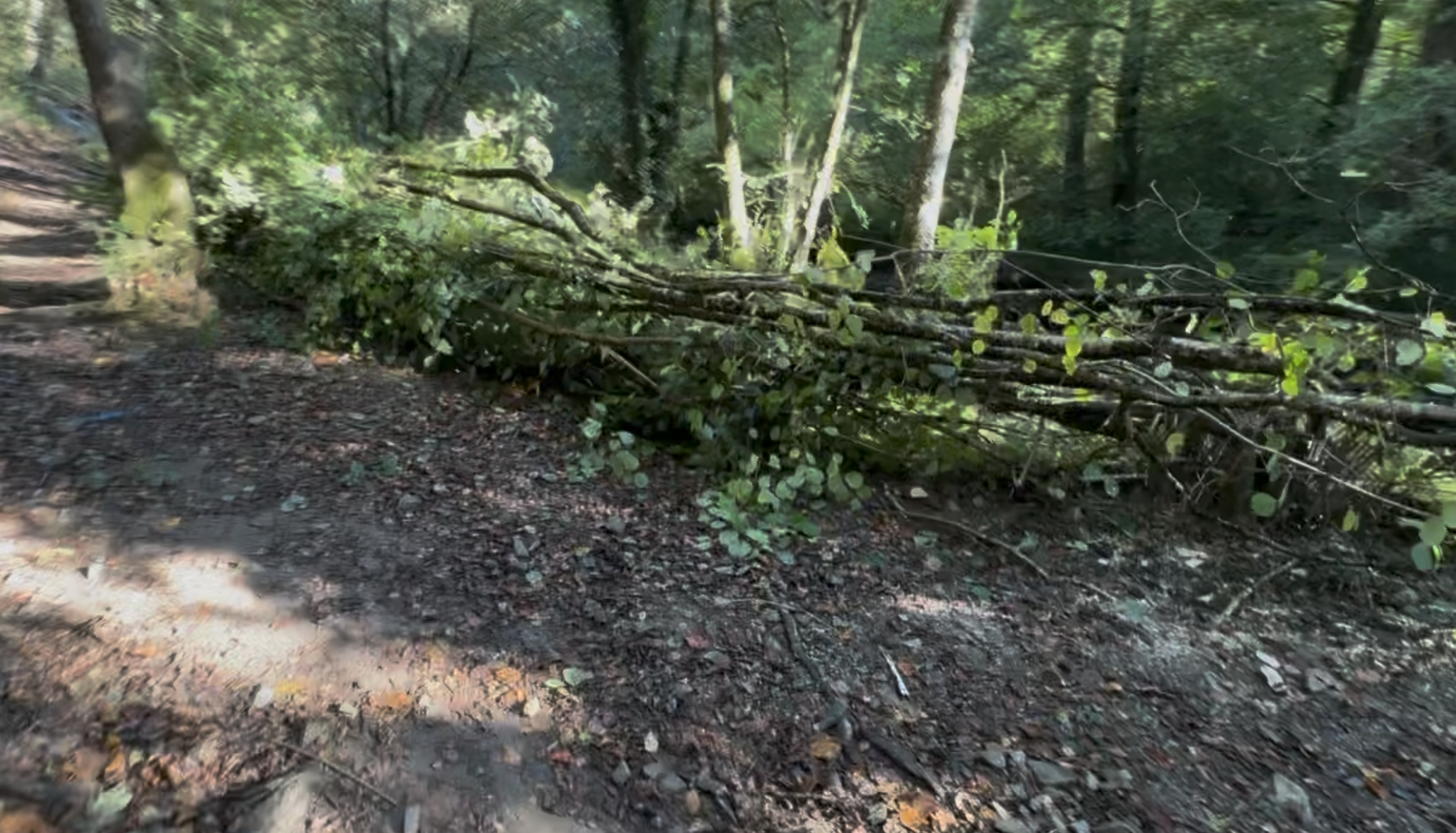
Something as simply as a live laid hedge is enough to guide walkers on a more suitable desire line…
Three unexpected visitors
And then, as if the river wanted to remind us exactly why we were there, something rather extraordinary happened. While making our way down towards the area where we'd be working, we spotted movement in the water. An otter. Then another. And another. A mother with her two kits, making their way downstream through the pools of the Fingle Gorge.
I've been fortunate enough to spend a great deal of time around the Teign catchment, and I've had some wonderful wildlife encounters over the years. But I honestly think this was one of the best otter sightings I've ever experienced…
It was a quiet morning, and the three of them appeared completely undisturbed by our presence. They continued downstream, exploring the pools and going about their business while we stood watching. For once, even I managed to stand still!
There's something quite extraordinary about seeing wildlife behaving naturally, apparently oblivious to the fact that a small group of people are standing nearby trying desperately not to make a sound. And when it's a mother with two youngsters, the experience becomes even more memorable. I managed to capture some of the encounter on video, which I'll share here.
It's moments like this that make all the hours spent moving timber, laying hedges, repairing banks and generally getting covered in mud seem rather worthwhile. Not because any single intervention guarantees that we'll see more otters, but because these encounters remind us what a functioning river habitat can support. The fish, invertebrates, vegetation, woodland and countless other species are all connected.
And somewhere amongst that complicated web of life are three otters having what appeared to be a thoroughly enjoyable morning. I doubt I'll ever witness a better otter sighting in the catchment. Although I'll certainly keep looking.
More to come
This recent session was also the first of several opportunities we'll have to work alongside the National Trust on further improvements to the Fisherman's Path. Starting in late November, we'll be joining them for additional volunteer days, including work alongside the Dartmoor National Park Youth Rangers. I'm particularly looking forward to that.
Getting younger people involved in practical conservation, helping them understand why we're doing the work and giving them the opportunity to contribute to places like Fingle Gorge is exactly the sort of thing we should be encouraging. I'll share more details about those dates separately, so keep an eye out if you'd like to get involved.
And a big thank you to our friends at the National Trust for inviting us to help with this work and for their continued commitment to improving the habitats and landscapes of the Teign catchment.
Following the right path
I suppose the interesting thing about desire lines is that they tell us something about ourselves.
We naturally seek out the places we enjoy. We follow the river because we want to see it, hear it and experience whatever might be happening around the next bend. And I wouldn't want that to change.
But perhaps understanding the effect of our footsteps is another part of learning to read the landscape. Because protecting a river isn't always about what happens in the water. Sometimes it's about what happens a few feet away from it.
A little more thought about where paths run, how banks are protected and where people are encouraged to walk can help reduce erosion, limit unnecessary sediment entering the river and give sensitive habitats an opportunity to recover.
And if we get that balance right, we can continue enjoying these extraordinary places while helping ensure that the wildlife living there has a future too. After all, I'd quite like somebody walking through Fingle Gorge in another twenty or thirty years to have the same opportunity we had that morning. To stop beside the river, look downstream and find themselves watching three otters exploring the pools.
Now that's something worth protecting. And as for Gala and the 90’s club scene!? Well, after spending the day re-establishing desire lines, I can confidently say I'm still not entirely Freed from Desire! Particularly when there's a river involved!