
Predators From Above
If you spend enough time on any river, you learn fairly quickly that not all threats to salmonids move through the water. Some swim, some crawl, some arrive with wings and excellent eyesight. On the Teign, our most efficient feathered fishers are the goosander and the cormorant - sleek, specialised piscivores doing exactly what nature designed them to do.
Don’t think that this is coming across as an anti-bird message - far from it. Rivers are ecosystems, not competitions, and wildlife has been eating other wildlife for longer than we’ve been around to name it! The point here is, once again, awareness: if we’re trying to recover declining salmonid populations, we need to understand all of the pressures acting on them, including the ones arriving from above.
Why Talk About Piscivorous Birds at All?
Because when it comes to salmonids, survival is a numbers game, and a brutal one of harsh statistics at that. As we touched upon previously, out of thousands of eggs laid each winter, only a tiny handful will ever make it back from the North Atlantic as adults.
But if we want to help salmon recover, we need to map their bottlenecks. Temperature stress, habitat loss, migration barriers, drought, ocean survival - and yes, avian predation - are all pieces of the same giant jigsaw puzzle.
Awareness isn’t about blame. It’s about understanding.
Meet the Feathered Fishermen
Goosander
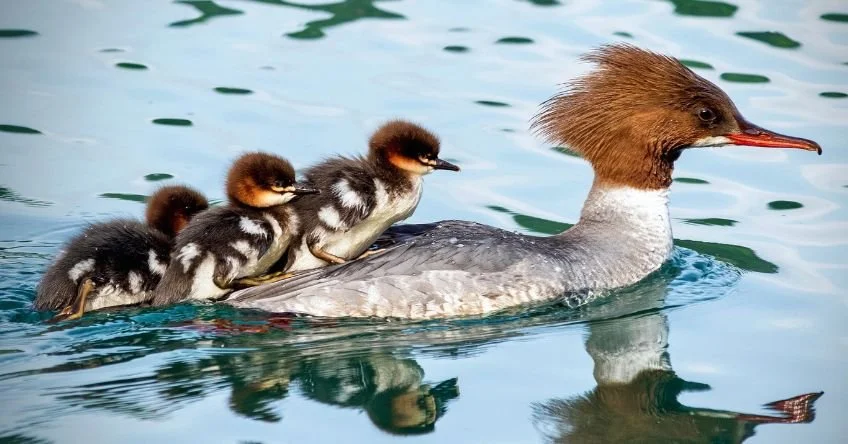
A sleek, serrated-billed fish specialist
Notes:
• often seen in lines or family groups
• narrow saw-edged bill for gripping fish
• surprisingly fast underwater
A single bird will consume around 400g of fish per day, and brood sizes can be surprisingly large. On the Teign, sightings of female + 8–12 chicks aren’t unusual. It doesn’t take too much maths to realise how that scales in a confined stretch of river.
Cormorant
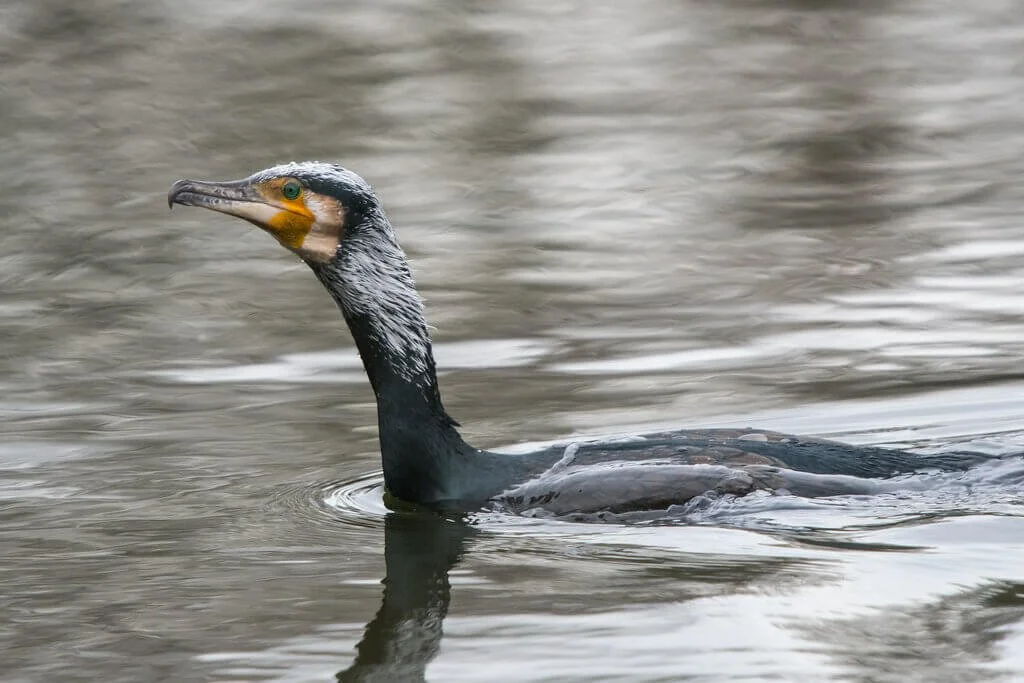
The black diver with a half-kilo appetite
Notes:
• deep diver
• hooked bill
• often roosts near weirs or deep water
Daily consumption is around 500g of fish per bird per day - half a kilo - which adds up quickly if they settle on a holding pool or lower valley section during the smolt run.
Weirs, Pools & Accidental Fish Buffets
Now here’s where geomorphology meets ecology. When a river encounters a barrier - natural or man-made - flow backs up, forming a holding, or weir pool. From a salmonid perspective, these are useful places to rest after tackling the obstacle if travelling upstream, or hold in until there’s more water to safely descend downstream.
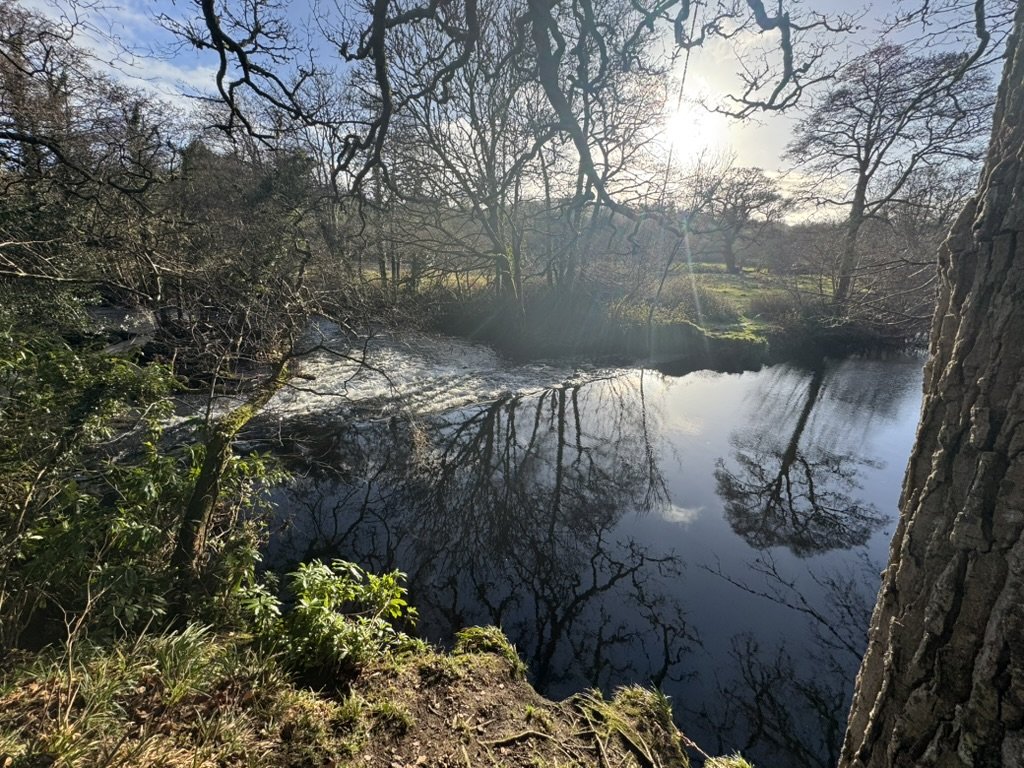
Chagford weir pool
From a bird’s perspective, they’re brilliant: slow water + concentrated fish + predictable movement.
In low-flow conditions, smolts migrating downstream can become delayed at these pools, increasing their visibility to birds with nothing better to do than sit, watch, and wait for lunch to arrive. Again - that’s not the bird’s fault. That’s the river offering food-focussed advantageous hydraulics!
Refuge, Complexity & Why Wood Matters
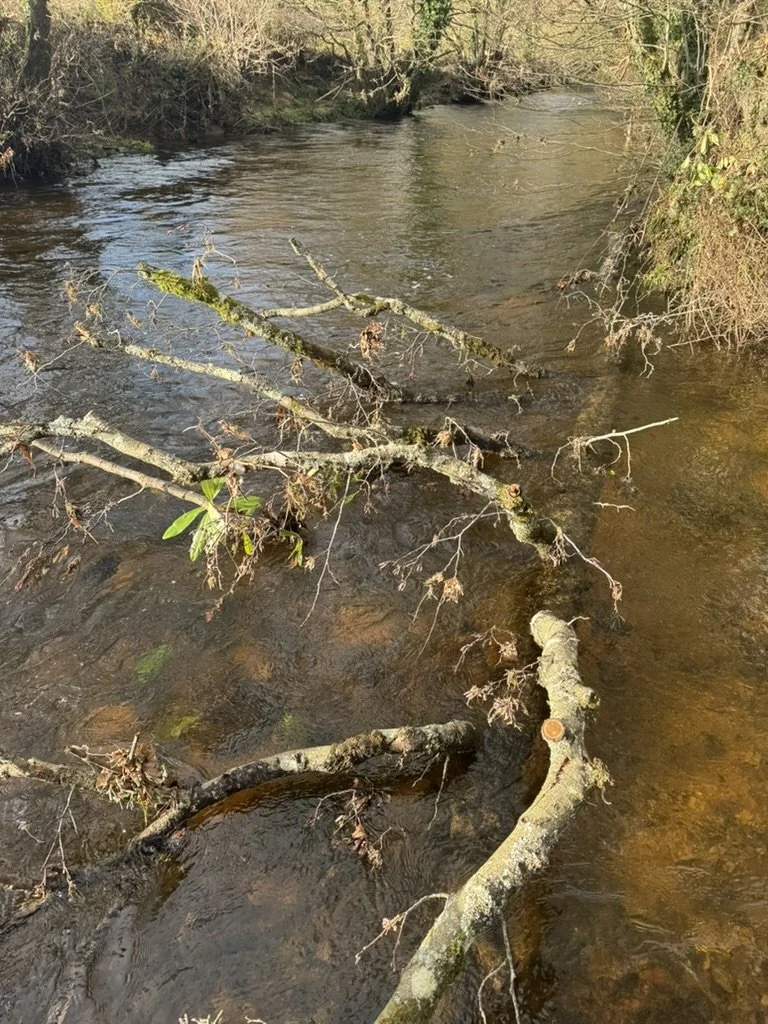
In contrast to open pools, woody debris creates cover and escape options - a natural underwater game of hide & seek where the fish occasionally win.
Woody material offers:
shadow cover
broken sight-lines
turbulence refuges
depth variability
visual complexity
This is one of the reasons we advocate keeping (or adding) wood to rivers. Beyond improving invertebrate life, gravel sorting and flow, wood literally keeps fish alive to become parr, smolts, and eventually, if they’re very lucky, returning adults.
Not Anti-Bird but Pro-understanding
It’s important to say this clearly: we’re not against wildlife doing what wildlife does.
Goosanders and cormorants are native components of the wider ecosystem (with the cormorant’s inland distribution being a more modern shift). What we’re trying to build is a clearer picture of how the catchment functions - where pressure points exist, how fish behave under changing flows, and where predation risk overlaps with migration bottlenecks. Reframe all of this as - Understanding informs action & Action supports recovery.
You can’t manage what you don’t understand - and you can’t understand what you don’t observe.
How You Can Help: Sightings Needed
To help us develop that picture, we’re asking anyone to report back sightings of:
goosanders
cormorants
and any associated behaviours (feeding, roosting, transiting, etc.)
Particularly useful are observations near:
weirs
holding pools
tributary junctions
lower-valley stretches
With Useful details including:
✔ date & time
✔ location (a what3words tag is gold dust)
✔ species & number of birds
✔ behaviour (fishing, resting, moving through)
No judgement. No blame. Just data - and the more eyes we have on the river, the better the picture becomes.
If you’d like to contribute sightings, simply use the button below. We’ll then get in touch to confirm you’re happy to be added to a Catchment WhatsApp group where observations can be shared quickly and easily. If that sounds like something you’re up for, just tap below.
Closing Thought
If Atlantic Salmon are to recover, they need our help at every stage along their journey - from redd to river to ocean and back again. Predation is natural, but understanding its patterns within our catchment helps us ensure that critical bottlenecks aren’t pushed beyond breaking point.
Awareness builds understanding.
Understanding builds better decisions.
And better decisions give the salmon half a chance.
Here’s to a more informed & observant 2026.